Process Logbook
Knowledge continuity for industrial operations, tied directly to your equipment.
Every shift change, every retirement, every resignation takes knowledge with it. The startup sequence that only works in the right order. The pump that runs hot when the river is low. The workaround somebody found at three in the morning and never wrote down.
Your historian records what the plant did. Process Logbook records what your people worked out about it, attached to the equipment it concerns, so it outlasts the shift that worked it out.
What it does
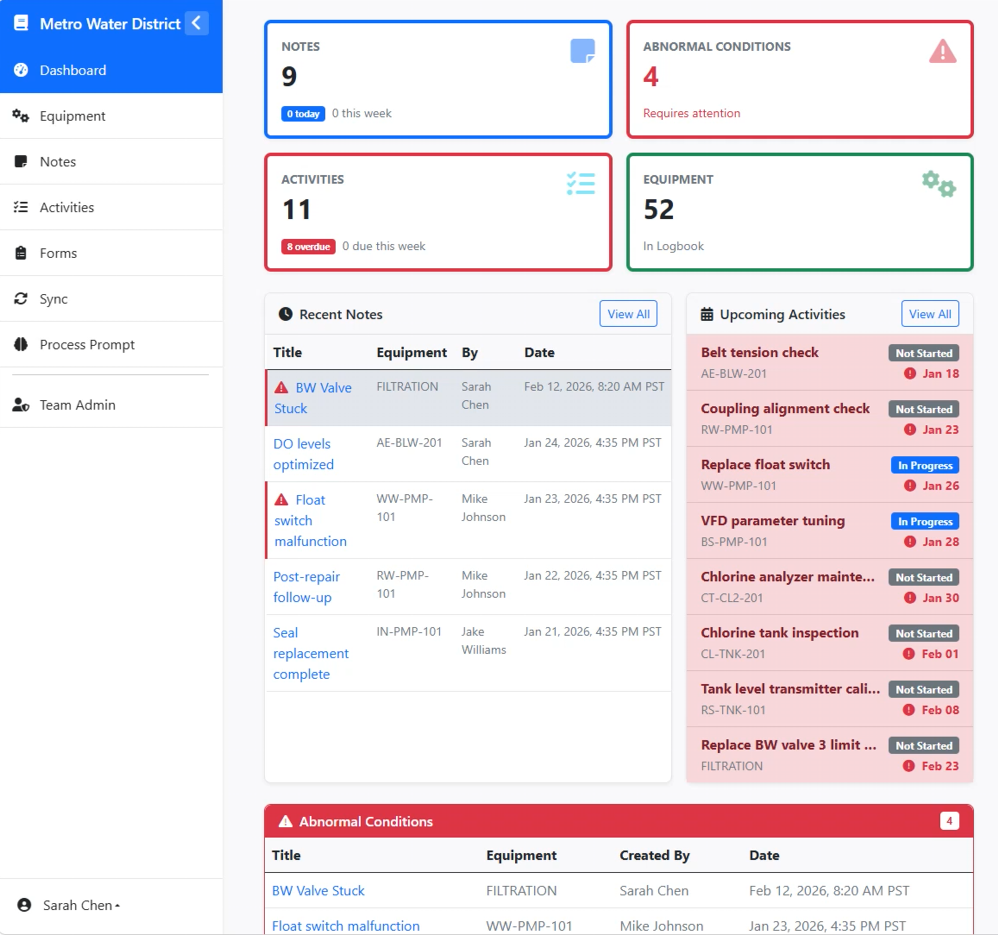
- Notes attached to equipment. Observations sit against the asset rather than in an inbox or a shared drive, so "what do we know about this pump" has an answer.
- Ordinary notes and abnormal condition notes. Abnormal conditions are flagged so they stand out from routine entries.
- Comments and attachments. Discussion threads on a note, plus photos, documents and drawings taken where the work happened.
- Activities and reminders. Scheduled follow-up tasks tied to equipment, so the thing that is not urgent today is not forgotten next month. Reminders go out over the same email and SMS connections Process Alert already uses.
- Works on a phone, including where there is no signal. The interface is responsive, and notes made out of coverage are held on the device and sent when the connection returns.
- Syncs across the control room, your network and the cloud. Notes made in one place appear in the others, with no manual export.
How it works
Three tiers. A control room tier inside the SCADA network, a web tier on your business network, and an optional cloud tier for phones and multi-site access. Notes, comments and attachments move between them automatically.
As with Process Alert, the direction of travel is what a security review cares about. Connections are always opened from the inside out. A site that wants nothing outside its own network can run the control room and web tiers alone and keep the whole note, comment, attachment and activity record.
Use cases
Shift handover. The night shift finds a strainer blinding faster than usual and cleans it twice. Rather than a line on a whiteboard that gets wiped by Tuesday, it goes against the strainer as an abnormal condition note with a photo. The day shift sees it on the equipment. So does the reliability engineer who pulls the asset's history three months later and finds the pattern.
Preserving what somebody knew. An operator with twenty years on the plant retires. What they knew about which valves seat properly and which need a second pass has been going against the equipment for the last two years, so it stays after they leave, and the person who takes over reads it in place rather than learning it again the hard way.
Questions
Is this a CMMS? No. It does not manage work orders or maintenance schedules. It captures the operating knowledge that never fits in a work order, and it sits alongside whatever maintenance system you already run.
Do we need the cloud tier? No. The cloud tier buys mobile access and multi-site sharing. A site that wants nothing leaving its own network runs the control room and web tiers and keeps the full logbook.
Can we run it without Process Alert? Process Logbook is built as an add-on to Process Alert and shares its equipment hierarchy and infrastructure. Ask us about running it standalone; we can usually arrange it.